OT Security for secure and resilient production

Industrial Cyber Security

Industrieller Roboterarm

Your expert for questions

Dr. Oliver Hanka

Dr. Oliver Hanka
Partner at PwC Germany
Tel: +49 160 5105836
Email

Securing production requires more than traditional IT Security

Rising regulatory requirements, the increasing connectivity of industrial systems and the growing threat of cyberattacks are presenting companies with new challenges. At the same time, production downtime, delivery delays and security incidents can have a significant financial impact.

Many companies recognise the need to act but face a number of fundamental questions: Where should we begin? Which risks are truly critical? What do NIS2 and IEC 62443 require? And how can we embed OT Security across our organisation for the long-term?

In pursuit of greater efficiency, companies are increasingly integrating Operational Technology (OT) with traditional IT systems. This convergence creates new attack vectors for targeted cyberattacks that can disrupt production. To this date, security efforts have focused primarily on protecting IT environments, with IT Security concepts often being applied to Industrial Control Systems without the necessary adaptations.

However, as attacks on safety-critical systems become more frequent, traditional IT Security measures are quickly reaching their limits. The 29th PwC Global CEO Survey illustrates the scale of the challenge: 34% of CEOs in Germany consider their companies highly or extremely threatened by cyberattacks, while 62% intend to significantly strengthen their Cyber Security capabilities over the coming years. Particularly in the manufacturing sector, where IT and OT are increasingly converging, OT Security is no longer a niche concern but one of the key priorities for the years ahead.


“If companies do not take targeted action to secure their OT environments today, they risk a complete production shutdown tomorrow.”

Dr. Oliver Hanka,Partner at PwC Germany

We help companies build a strategic, practical approach to Industrial Cyber Security, meet regulatory requirements and strengthen the long-term resilience of business-critical production and operational processes.

Combining strengths for your security

From governance and compliance to architecture, monitoring and penetration testing, we provide end-to-end support for your OT security initiatives.

Clients across industries, incl. manufacturing, automotive, chemicals, transport and critical infrastructure - rely on our technical and operational OT Security expertise.

We translate requirements such as NIS2, the German KRITIS-Dachgesetz, IEC 62443 and ISO 27001 into concrete measures that deliver measurable value for your organization.

The increasing connectivity of Industrial Control Systems requires new security concepts. We combine OT, IT, Cloud and AI Security to create an integrated approach.

< Back

< Back
[+] Read More

Our Industrial Cyber Security services

Gain clarity on regulatory requirements, identify gaps and embed compliance sustainably

A robust OT Operating Model and an embedded ISMS/CSMS as the foundation of your Industrial Cyber Security

Structured risk and threat assessments in accordance with IEC 62443 as the foundation for robust OT Security

Secure OT and enterprise architectures that meet requirements and enable new business models

Detect attacks on your OT environment early and respond quickly, from proof of concept to production operation

Rapid risk reduction through targeted OT assessments, penetration testing and remediation

< Back

< Back
[+] Read More

How resilient is your OT environment?

Get an initial assessment of your OT Security posture and identify the main areas for action.

Our holistic approach to securing OT systems

Infografik: PwCs ganzheitlicher Ansatz zur Sicherung von IoT-Produkten, IoT-Plattformen und OT-Systemen

The diagram presents our structured mapping of IEC 62443 requirements across ten security domains.[SF9.1] The outer ring illustrates that governance requirements - such as roles and responsibilities, policies and control mechanisms - must be considered across all domains, similar to the NIST Cybersecurity Framework. Employee training and security awareness are also cross-cutting topics, as employees in every area must have the security knowledge required to perform their roles. This structure enables the systematic allocation of requirements, measures and responsibilities, thereby simplifying the application of the standard.

Industrial Cyber Security in the age of AI

Artificial intelligence is increasingly being integrated into industrial processes, production control and maintenance. This creates new opportunities for efficiency and automation but also expands the attack surface and introduces additional risks. Companies must therefore not only secure traditional OT systems but also ensure that AI-enabled technologies are used safely and securely. We support organizations in developing appropriate governance structures, security controls and Operating Models for modern industrial environments.

Frequently asked questions

Industrial Cyber Security protects industrial control and automation systems against cyberattacks. Unlike traditional IT Security, it primarily focuses on availability, operational safety and uninterrupted production processes - for example, in manufacturing, energy supply and critical infrastructure.

The IEC 62443 series is internationally recognized as the key standard for securing industrial systems. In the EU, NIS2 requires many companies to implement enhanced Cyber Security measures, while the German Critical Infrastructure Umbrella Act (KRITIS-Dachgesetz) governs the enhanced protection of critical infrastructure.

Key areas include network segmentation, access and identity management, vulnerability and patch management, anomaly and threat detection, emergency planning and the interplay between operational safety and cyber security. 

In IT environments such as laptops and servers, confidentiality and integrity come first. In OT environments such as robotic arms and sensors, availability and physical safety are critical. OT systems run for decades, patches require planned downtime, and failures can harm people or the environment, so OT needs security approaches beyond conventional IT.

IT/OT convergence refers to the integration of Information Technology (IT) and Operational Technology (OT). Production systems are becoming increasingly connected, while more standard IT components are being deployed within industrial networks. This improves efficiency and enables greater use of data but also expands the potential attack surface.

Common risks include ransomware, which encrypts systems and data and renders them inaccessible; unauthorized access via remote maintenance connections; unsecured legacy systems; and misconfigurations. Insider threats also pose a significant risk to industrial environments. 

The use of AI offers significant potential to enhance OT Security. It enables, for example, earlier detection of anomalies and more effective alert prioritization. In addition, AI introduces new risks, including incorrect decisions, and AI-enabled cyberattacks. Therefore, AI should only be deployed in OT environments under controlled and monitored conditions.

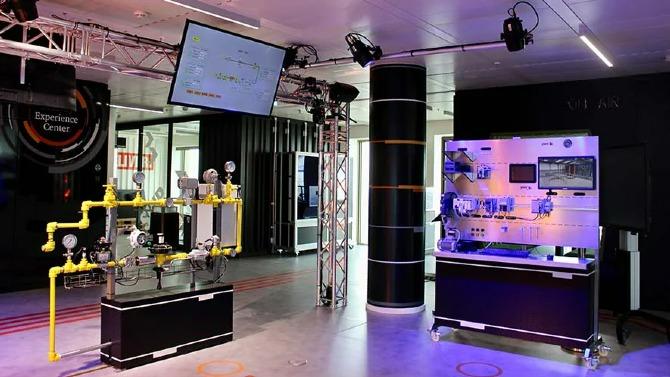
PwCs Cyber Security Experience Center in Frankfurt am Main

PwC’s Cyber Security Experience Center in Frankfurt

Experience first-hand how cyberattacks impact OT and IT infrastructures and explore effective defense strategies.

Learn more

Industrial Cyber Security Asset Library

Explore our knowledge hub featuring white papers, webcasts and events for the latest insights into Industrial Cyber Security.

Learn more

“Securing industrial facilities is about maintaining production, ensuring workplace safety, and meeting regulatory requirements to keep business operations resilient and running.”

Sebastian Frenzel,Senior Manager at PwC Germany
Follow us

Contact us

Dr. Oliver  Hanka

Dr. Oliver Hanka

Partner, Cyber Security, Data & Tech Risk, PwC Germany

Tel: +49 160 5105836

Sebastian Frenzel

Sebastian Frenzel

Senior Manager, Cyber Security, Data & Tech Risk, PwC Germany

Tel: +49 1512 9257784

Hide