




In April 2024, China’s State Council released a guideline on strengthening supervision and promoting development of the country’s capital markets. The overall goal is to establish a framework within five years and build a competitive and inclusive capital market by 2035. Widely referred to as the new National Nine Articles (NNA), the updated rules have changed the way companies are doing business in China.
Core Components of the NNA
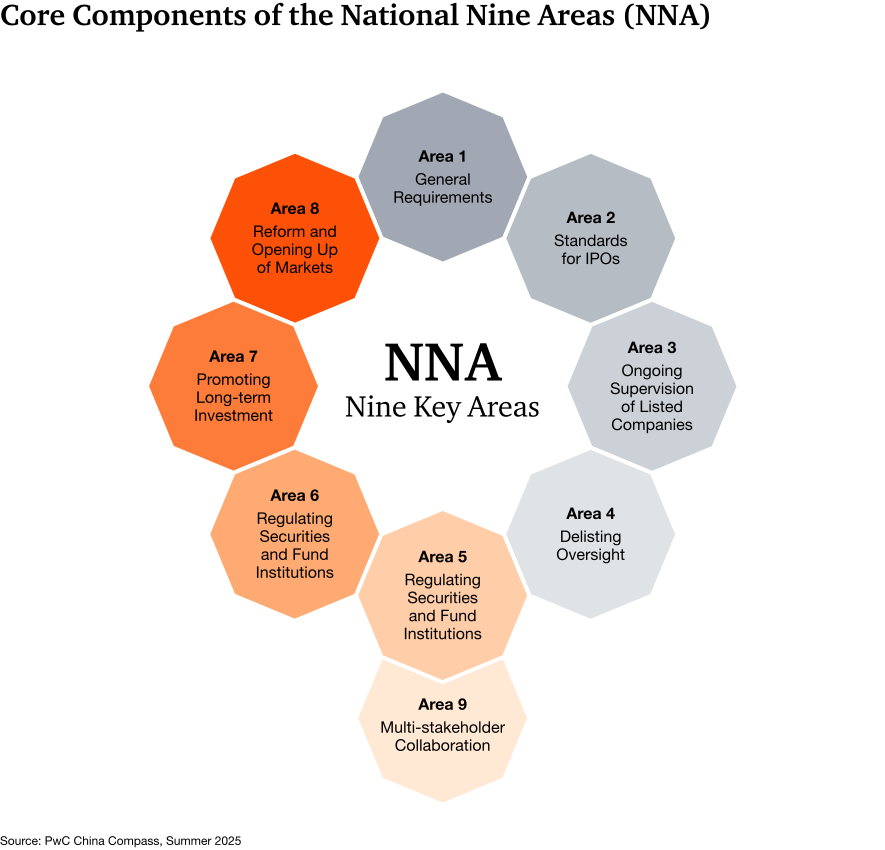
The NNA encompasses nine key areas, as depicted in the graphic below. The first area lays out the general requirements that reflect the overarching goals for market development. The second sets strict standards for initial public offerings (IPOs), enhancing the scrutiny of listing qualifications, while the third addresses the ongoing supervision of listed companies as a way of strengthening compliance and governance.
The NNA’s fourth area intensifies delisting oversight to ensure market vitality through rigorous exit mechanisms. Regulating securities and fund institutions is the goal of the fifth area, a next step towards refocusing the industry on its core functions and fostering excellence. The sixth area enhances trading supervision to bolster market stability.
Promoting long-term investment and encouraging sustained participation by institutional capital is the seventh area addressed by the NNA, while the eighth offers a comprehensive reform and opening up of markets to support high-quality economic growth. Finally, the ninth area promotes coordinated efforts for market development to facilitate multi-stakeholder collaboration.
Current institutional oversight
In terms of the current institutional framework, the China Securities Regulatory Commission (CSRC), the Shanghai Stock Exchange (SSE), and the Shenzhen Stock Exchange (SZSE) have established rules governing a range of issues, including IPO reviews, spin-off listings, refinancing, mergers and acquisitions, sponsorship, issuance and underwriting, stock trading and transfer listings.
While the country’s main boards feature mature, industry-leading enterprises, SSE’s STAR Market focuses on cutting-edge technology and firms offering core innovations, stable business models and high growth potential. SZSE’s ChiNext, in contrast, serves innovative, growth-oriented enterprises, particularly those integrating traditional industries with emerging technologies and business models.
Reviews and inspections for IPOs
Enterprises wanting to go public must meet a number of requirements, including market capitalization and financial benchmarks. They must also demonstrate financial compliance and operational independence, not to mention lawful conduct. Major instances of negative publicity, moreover, could thwart their attempts to become listed.
Companies wanting to go public are subject to review both from exchanges and from the authorities. The SSE and SZSE conduct independent assessments, supported by specialized committees such as the STAR Market’s Science and Technology Innovation Advisory Board. Oversight here focuses on compliance with listing standards and disclosure quality. In addition, the CSRC evaluates alignment with national industrial policies and sector positioning, finalizing registration based on exchange recommendations.
Companies can also undergo on-site inspections, with random visits to 20% of applicants taking place quarterly. Targeted inspections are conducted to address unresolved material issues affecting listing eligibility.
Investor-centric approach required
When it comes to disclosures, issuers must ensure all information provided is true, accurate and complete and that it is presented in a clear, concise and investor-friendly manner. Moreover, it must be free of false statements and misleading representations, and have no material omissions. The stock exchanges review companies’ disclosure documents to enhance their completeness and quality.
To meet the new requirements, issuers must adopt an investor-centric approach, aligning disclosures with their sector positioning and industry trends. Disclosures must address the enterprise’s business model, corporate governance and development strategy, as well as operation and accounting policies and financial analysis. They must also cover risk factors, profitability status (if the company is not profitable), the reasons for any performance decline, and the dividend policy. Information on the use of proceeds, dual-class share structures (if any) and lock-up arrangements must also be included.
Qualifying as a major restructuring
Companies undergoing reorganization should be aware that a transaction qualifies as major restructuring if any of the following thresholds are met:
- The total assets purchased/sold exceed 50% of the company’s latest audited consolidated total assets.
- The revenue generated by the assets purchased/sold exceeds 50% of the company’s latest audited consolidated revenue and surpasses CNY 50 million.
- The net assets purchased/sold exceed 50% of the company’s latest audited consolidated net assets and surpass CNY 50 million.
For STAR Market and ChiNext listings, the acquired assets must align with the company’s sector positioning. They must also belong to the same or related industries, and demonstrate synergies with the company’s core business.
Threat of backdoor listings
Something companies must watch out for is being classified as a backdoor listing. Authorities in China will regard a deal as a backdoor transaction if, within 36 months after a change in control, a listed company acquires assets from the acquirer or its affiliates that exceed 100% of the company’s audited consolidated total assets in the fiscal year before the transaction. The same applies if revenue from the acquired assets exceeds 100% of the company’s audited consolidated revenue in the fiscal year before the transaction, or the acquired net assets exceed 100% of the company’s audited consolidated net assets. In addition, shares issued for the acquisition may not exceed 100% of the company’s total shares as of the trading day before the board resolution approving the transaction. Finally, companies must avoid any other scenario that materially alters their core business, even if the above thresholds are not met.
Lock-up periods and price protection
Companies must follow some general rules when it comes to issuing shares for asset acquisitions. For example, they may raise supporting funds concurrently when issuing shares for asset purchases. In terms of pricing, the issue price cannot be lower than 80% of the market reference price (20/60/120-day average prior to announcement of the board resolution).
There is a standard 12-month lock-up period for shares obtained via asset contribution. Alternatively, the lock-up period is 36 months if the investor is the controlling or actual shareholder or an affiliate, if the transaction results in a change of control, or if the investor held the contributed assets for less than 12 months.
Another important aspect is the price protection clause, which mandates that controlling shareholders must extend the lock-up by six months or more if either the share’s closing price for 20 consecutive trading days is less than the issue price within six months of the deal, or if the closing price is less than the issue price at the six-month anniversary of the transaction.
Adequate disclosure, relevant positioning
The exchanges evaluate whether any potential restructuring meets the eligibility criteria and whether the relevant disclosures are adequate. Key considerations here are the necessity of the transaction, the fairness of the asset’s valuation, the feasibility of performance commitments and if the listed company’s or shareholders’ interests are protected.
For the STAR Market, moreover, the target asset must be aligned with the STAR segment’s positioning and offer industry synergy, i.e. it must service the same or upstream/downstream sectors. Similarly, ChiNext transactions must reflect ChiNext positioning and offer synergies with the acquirer’s core operations.
Conclusion
As a major regulatory overhaul, the NNA has impacted the workings of China’s capital markets and, above all, added a host of new rules that companies and investors must remain aware of as they do business in China or with Chinese partners.

Xuemei Li
Ms. Li Xuemei is a partner specializing in A-share capital markets and accounting consulting services. She joined PwC in 1995 and has been involved in the shareholding system reform, IPO listings, major asset restructuring, and acquisition projects of multiple companies. She is well-versed in Chinese enterprise accounting standards and the relevant regulations and procedures of the capital market, and has accumulated extensive experience in capital markets, industries, accounting, and audit techniques. Since November 2018, she has actively participated in the research and feedback on policies related to the registration-based system and the STAR Market and ChiNext. From 2009 to 2010, she was seconded full-time to the Chief Accountant's Office of the China Securities Regulatory Commission (CSRC); in 2013, she served as a visiting researcher at the Chinese Institute of Certified Public Accountants (CICPA); from 2018 to 2022, she was a member of the Strategy Committee of the Beijing Institute of Certified Public Accountants (BICPA); since November 2020, she has been a member of the Accounting Professional Advisory Committee of the Shenzhen Stock Exchange (SZSE).
Tel.: +86 (10) 6533 3927
E-Mail

Keane Zhou
Keane Zhou has more than 20 years audit experience in PwC Shanghai. He has a proven track record of providing audit services for Mainland China/HK listed companies and multinational corporations, with a particular focus on German inbound business and Sino-German acquisitions. With two years of expatriate experience in Frankfurt am Main, Germany, Keane has gained valuable international insights and expertise. His client portfolio is diverse, encompassing Public Interest Entities, Chinese State-owned Enterprises, multinational corporations with operations in China, and private companies. The industries he serves include auto parts, healthcare, manufacturing, consumer goods, chemicals, mining, and semiconductors, showcasing his broad industry knowledge and adaptability.
Tel.: +86 (21) 2323 2292
E-Mail

Yansheng Wu
Yansheng joined PricewaterhouseCoopers Zhong Tian LLP, Beijing Branch, in August 2006 and has been serving since then. He worked in the assurance department from August 2006 to October 2014 and transferred to the Capital Market Services Group since November 2014. Yansheng was promoted as partner in this department since July 2021. From February 2017 to February 2018, Yansheng was seconded full-time to China Securities Regulatory Commission as a capital market expert to assist accounting and auditing matters encountered in China capital market. Yansheng acts as A-Share capital market expert to discuss, identify and resolve key issues related to A-Share listing with top management of companies, handle complex accounting and auditing issues, assist companies in preparing prospectuses and responding to inquiries from Shanghai/Shenzhen Stock Exchange and China Securities Regulatory Commission, assist sponsors and lawyers in related work; He also assists A-Share listed companies in their major asset restructuring transactions. In recent years, successful A-Share IPOs with his expertise and deep involvement include Shanghai United Imaging Healthcare, Shenzhen Mindary Bio-medical Electronics, Shanghai Electric Wind Power Group, Dizal (Jiangsu) Pharmaceutical, CanSino Biologics, Beijing Sinocelltech Group, Beijing Jenkem Technology, Beijing Roborock Technology, Shanghai VicoPrecision Mold &Plastics, Eastroc Beverage, Qingdao Port International, Jiangsu Financial Leasing, etc.
Tel.: +86 (10) 6533 5906
E-Mail

Melissa Bao
Melissa Bao is an audit manager based in Shanghai at PwC. With a wealth of experience in the auditing field, she has provided audit services to numerous multinational corporations. Additionally, she has extensive experience serving A-share listed companies in China. Melissa's professional journey includes a two-year assignment at PwC in Frankfurt, where she gained valuable international exposure and expertise. Her background equips her with a unique blend of global and local insights, making her a highly effective audit professional. Melissa has been with PwC for six years, during which she has consistently demonstrated excellence and commitment to her work.
Tel.: +86 (21) 2323 2814
E-Mail
Interested in knowing more?
Make sure you get the latest information and subscribe. As a subscriber to the digital edition, you will receive an information update three times a year.
PwC China Compass
You will discover how to take advantage of current opportunities and safely circumnavigate the risks of doing business in China.


Follow us